Pain Points We Solve
Agent frustrations almost always trace back to one root cause: the model has no durable memory of your project, so nothing you teach it sticks. Here's what that costs — and what a .human/ workspace gives you instead.
What changes
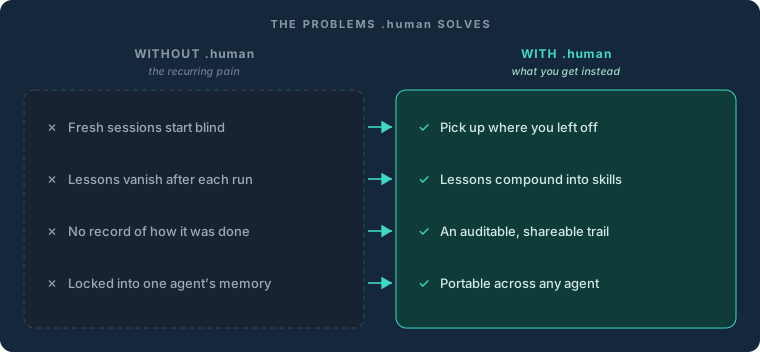
dotHuman doesn't make the agent smarter — it gives the work a place to live, so progress accumulates instead of resetting. Each row pairs a familiar pain with what changes once there's a .human/ the agent can inherit.
| The pain | What you get instead |
|---|---|
| Every session starts from zero A fresh agent thread has no context from the last one — you re-explain the architecture, conventions, and past choices every time. |
It picks up where you left off The agent primes itself from the .human/ workspace, inheriting your conventions instead of re-briefing from scratch. |
| Hard-won lessons evaporate The fix you found yesterday is gone today, and the agent repeats the same mistake. |
Lessons compound Takeaways get written down as you go; small ones mature into durable, reusable runbooks the agent reaches for on its own. |
| No record of how — or why Weeks later nobody can reconstruct the reasoning behind a decision — the context lived in a chat window that's gone. |
An auditable trail Goals, decisions, and execution logs live in your project, surviving context resets and team hand-offs. |
| Knowledge is trapped in one silo The working method lives in one person's head or one prompt history, so hand-offs are messy. |
Portable team knowledge The method is plain-text files at the project root — readable by any developer or fresh agent. |
| Vendor and model lock-in Switch model or tool and the context you built up in one tool's history is lost. |
Tool-agnostic Plain text and folder conventions, so your method moves across any file-capable AI tool. |
| The human gets pushed out Left unmanaged, agents run ahead on wrong assumptions and you lose control of what ships. |
You stay in the loop You steer the spec, review progress, and sign off on what ships. Be the dotHuman in the loop. |
Where to go next
- New to the idea? Introduction — what it is, in about two minutes.
- Want to see it work? Quickstart — a dotHuman on a real project in ~five minutes.
- Want the mechanics? How dotHuman Works — the two ideas everything else builds on.
Related
Last updated