What's in a Name?
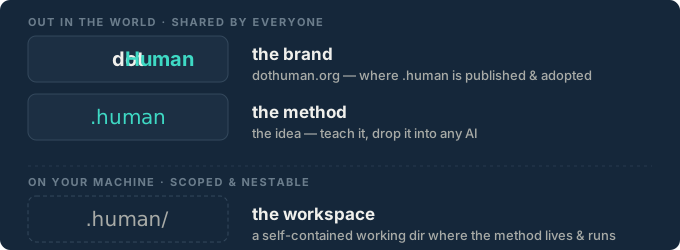
dotHuman (the brand) and .human (the method) live out in the world, shared; .human/ is the self-contained workspace it runs in — on your machine, scoped to where you work, and nestable.Open a brand-new project folder and look closely — it's already quietly crowded with dotfiles. .env, .gitignore, .vscode — every developer knows these and edits them without a second thought. Each is a small set of standing instructions, hand-tuned config for one tool or another. For years that's just been the furniture of software: a hidden file for every machine that touches the code.
Then AI agents started writing the code alongside us, and a small gap appeared that none of those files filled: every machine in the project had somewhere to keep its preferences, but the human didn't. That's where the name came from. .human is the dotfile for the person — your working method, finally given a home of its own, sitting right there beside all the machines' config.
The three names, kept straight
They share one root, so people blur them together. Keep them apart and the rest of the handbook falls into place:
- dotHuman — the brand: what you visit and adopt at dothuman.org. It runs on
.humanand publishes it (the thing you get). .human— the method: the open, tool-agnostic operating layer you describe, teach, and drop into any AI (the idea)..human/— the workspace: the self-contained folder on disk where the method actually lives and runs. You can nest one per scope — a root, then one inside each subdomain.
Where it sits
These names fix the vocabulary the rest of the handbook uses (Figure 1). Keep .human (the method) and dotHuman (the brand) apart, and .human/ reads as the method's self-contained workspace on disk — see the two layers and .human/ & git for how that workspace behaves.
Example
dotHuman        # the brand     — the thing you get (dothuman.org)
.human          # the method   — the idea, drop into any AI
.human/         # the workspace — self-contained dir; where it lives & runs
Using each, precisely. Three uses, three names: when you point someone to adopt or visit, say dotHuman; when you teach or argue about the method, say .human; when you mean a path on disk, say .human/ (always with the slash). The first two are shared and singular — one brand, one method, the same for everyone, out in the world. The third is yours: local, and as many as you need — a .human/ at the root, another inside each scope you work in, each one the method running in its own corner of the project.
Related
Last updated